Strip away the labels and lateralworks uses AI for exactly one job: synthesis. It reads the scattered data a program throws off — schedules, status notes, assumptions, economic parameters — and returns one organized structure the core team can act on. The model accelerates the work. It does not make the call.
Why synthesis is the bottleneck
In most programs the slow step is not deciding. It is getting to the point where a decision can be made. Pulling inputs together, reconciling them, and laying them out in a form the team can scrub absorbs hours that should go to judgment. AI compresses that step from days to minutes, and the consolidated picture comes out higher in quality than hand assembly produces. For a program committed to nine products in two years, that compression is a force multiplier on the schedule.
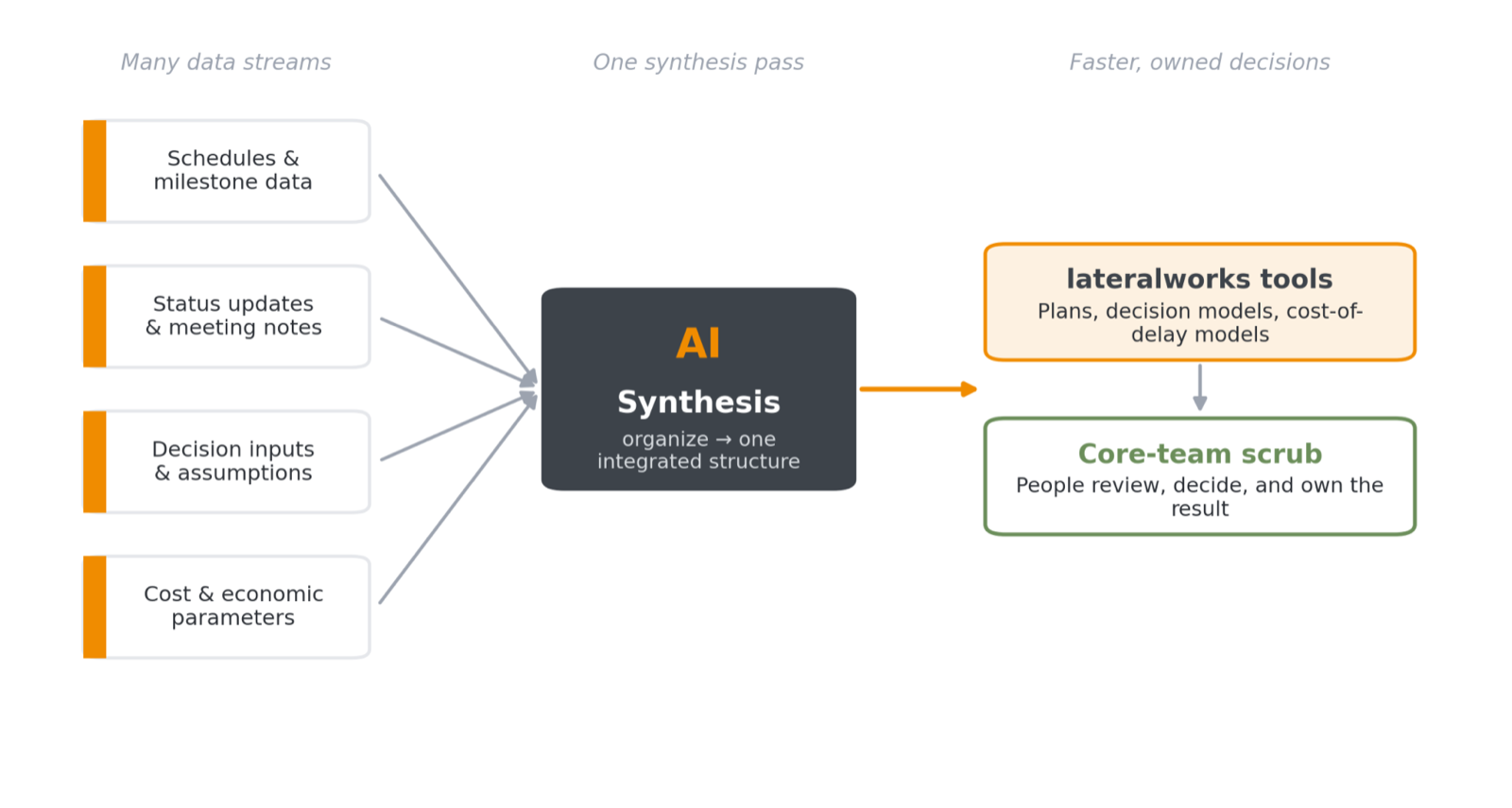
Figure 1. The synthesis pattern. AI consolidates many data streams into one structure that feeds the lateralworks tools. A human core team reviews, decides, and owns the outcome.
Five points where AI works in the FTTM workflow
We apply AI at five points, and at every one the output feeds a human decision rather than making it. Planning and tracking: the milestone timeline and matrix are synthesized from raw inputs, so the team scrubs a consolidated draft instead of hand-building one. Decision-making: AI helps construct the decision model and read what it is saying. Economic modeling: cost-of-delay models are built and analyzed with AI support, which is what lets a program prioritize correctly when everything feels urgent. Schedule evaluation: AI surfaces gaps and risks earlier than a manual read, while there is still room to act. Status reporting: weekly reports are drafted from program data, and the manager edits and owns the result.
Match the control to the data
Data sensitivity is not one level, so the control should not be either. By default lateralworks runs on a configuration where the provider does not train on conversations and retention is short. As data gets more sensitive, the posture escalates: commercial and enterprise terms, then an API path with a data-processing agreement and near-zero retention, and at the top an isolated model that runs entirely inside the client firewall so data never leaves. That top rung is in active use, not theoretical — through a strategic partner, lateralworks has helped a client stand up an internal LLM inside their own firewall.
What always stays human
Every application here produces an input to a decision. None of them produces the decision. The synthesized plan, the model result, the cost-of-delay read, the schedule risk, the status draft — each lands in front of the core team, which scrubs it, challenges it, and signs off. The tools do not approve plans, commit dates, or accept risks. People do. Keeping the human in command is what makes the speed safe: a team that owns every decision can move fast on the synthesis because the judgment still runs through it.
lateralworks uses AI to consolidate many data streams into one structure that feeds its planning and decision tools, handled under a posture matched to the data, and always owned by the human core team.