Most innovation scorecards fail the same way. Someone collects every metric the functions already track, arranges thirty of them on a dashboard, and the leadership team reads it once a month the way you read a weather report: with interest, and without consequence.
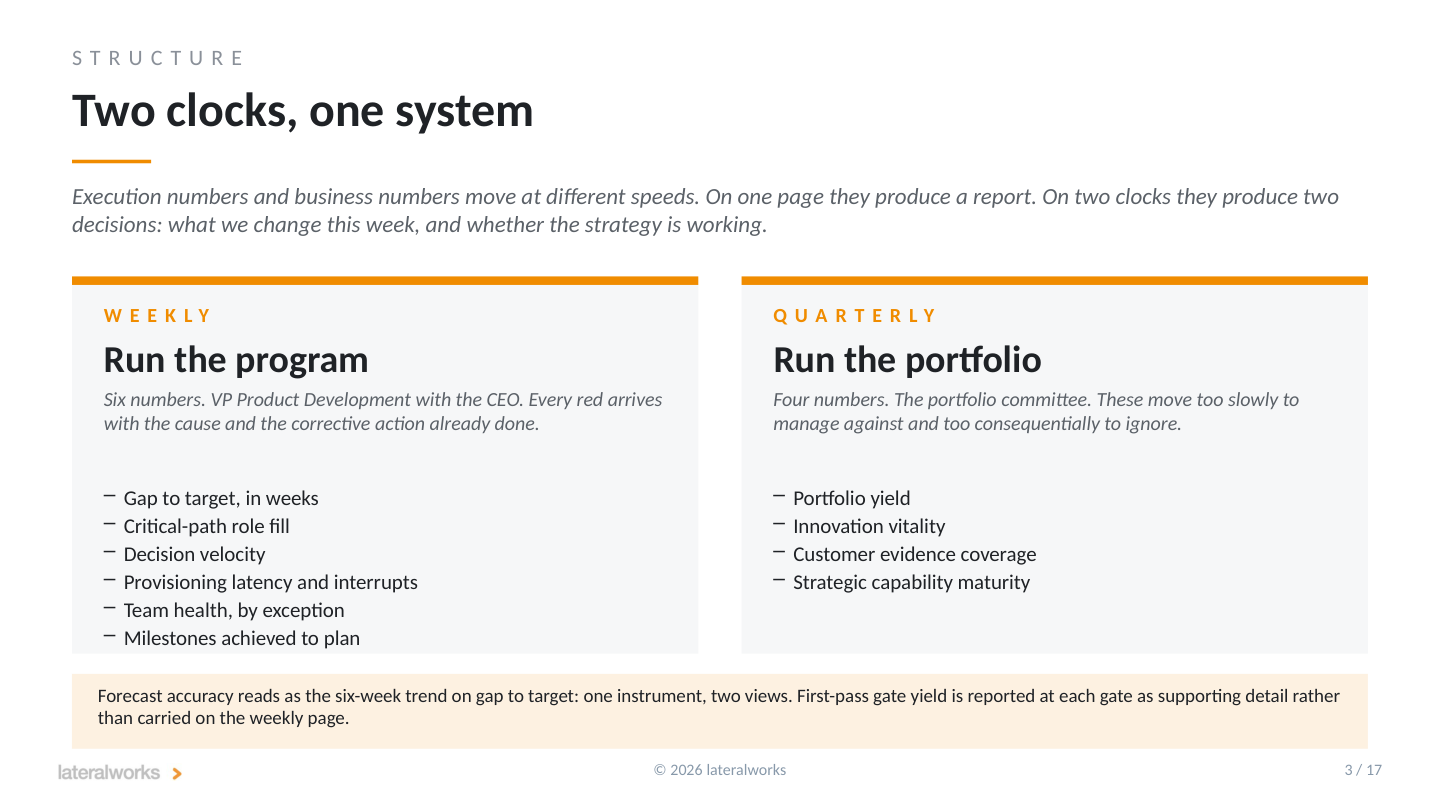
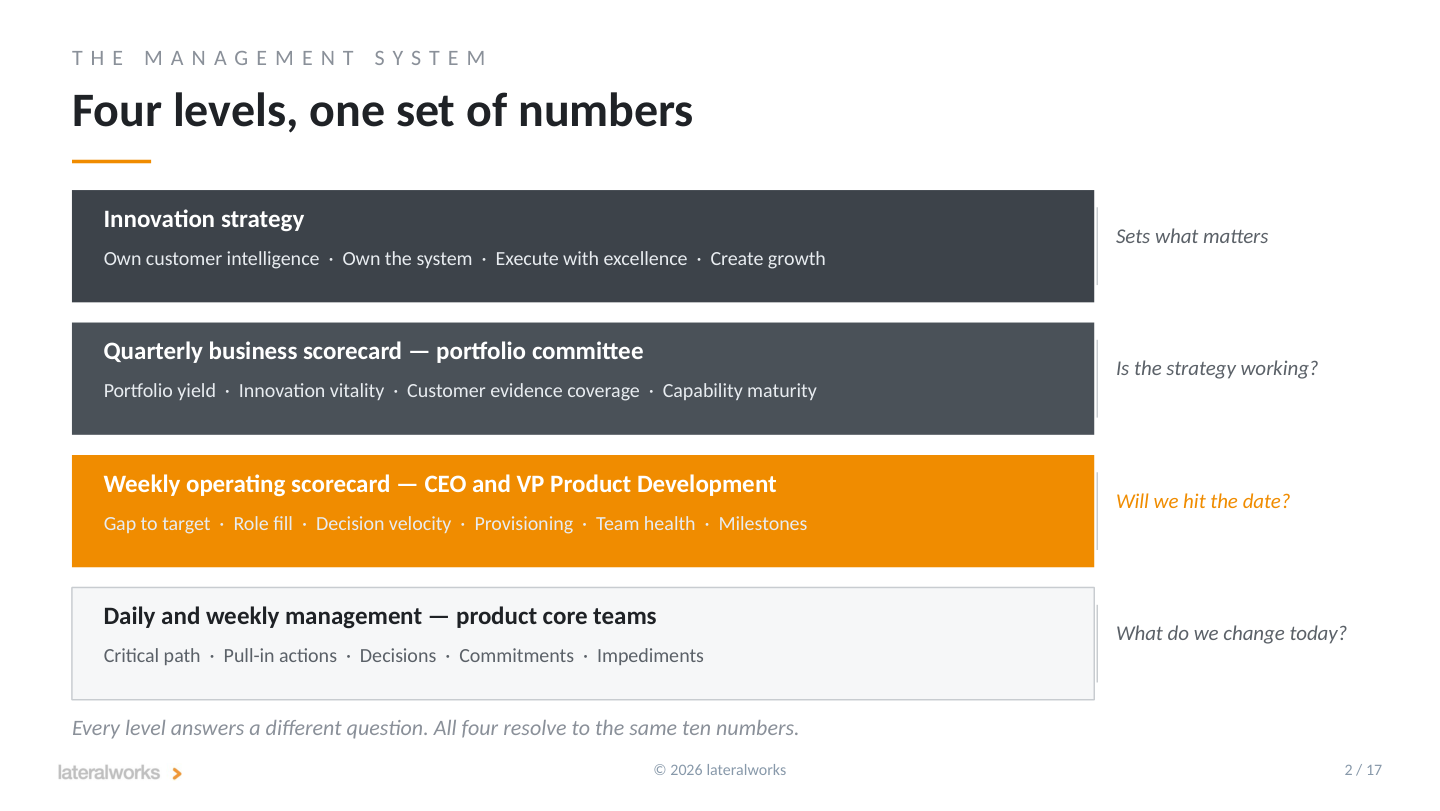
The fix we built with a recent client is small enough to state in a sentence. Ten numbers, on two clocks. Six numbers reviewed weekly to change the date. Four numbers reviewed quarterly to judge the strategy. Everything else moves to supporting detail, reviewed at the gate or on exception.
The two clocks matter more than the ten numbers. Execution numbers and business numbers move at different speeds, and when you put them on one page at one cadence you get a report. Split them onto their own clocks and you get two different decisions: what we change this week, and whether the strategy is working. A leadership team that reviews the vitality index weekly learns to ignore it, because it never moves. Review gap to target quarterly instead and the slips arrive a quarter after a pull-in action could have recovered them.
Every number sits on a practice
None of the ten metrics was invented for the scorecard. Each one is a measurement placed on top of an FTTM best practice the organization is already implementing, and that is what makes the number actionable. A metric with no practice behind it is a complaint; a metric attached to a practice tells you which lever to pull.
The weekly six, and the practice each one measures:
Gap to target measures the weekly schedule refresh. The bottom-up critical path, refreshed every week, against the committed date, in weeks, per team. This is the targets-and-trends discipline: the target stays fixed, the forecast tells the truth, and the trend between them is the management information. Its six-week trend also carries forecast accuracy, so one instrument serves two views.
Critical-path role fill measures the dedicated core team practice. Fast teams are small, dedicated, and fully staffed on the critical path. The definition carries the teeth: filled means named by the functional manager and released to the team. A name on an org chart with no released time counts as zero.
Decision velocity measures the bounding box. When decision rights are defined, roughly 80 percent of decisions belong inside the team, and the median days from decision identified to decision made is a direct read on whether that is happening. Slow decisions are the quietest way a fast program dies.
Provisioning latency and interrupts measure the host. Five of the six weekly numbers measure the teams; this one measures leadership. How long a resource request waits before it is actually released, and how many times in the trailing year the organization reversed a decision late or pulled a resource off a critical path. Teams already generate this data on the impediment row of their daily board, so the metric comes free.
Team health by exception measures the operating standard, and it encodes the aggregate-then-drill-down rule: report every team against the eight criteria, worst first, and never publish a portfolio average. An average across eight teams can look comfortable while the team on the critical path is failing.
Milestones achieved to plan measures the rhythm of accountability. Gates and releases passed against plan, year to date. It is the lagging confirmation that the five leading numbers above it are telling the truth.
The quarterly four follow the same rule at business speed. Portfolio yield and innovation vitality measure whether the portfolio is producing new revenue: the right-time discipline of treating development as a financial instrument. Customer evidence coverage measures the fuzzy front end: the share of active programs that entered development with real customer evidence behind them, counted before the commit, because the front end is where programs lose time they never recover. Capability maturity measures whether the organization is building the muscles the strategy assumes it has.
One number connects the clocks
Cost of delay is the exchange rate between them. Every team carries its own figure, in dollars per day, published to the team rather than held at portfolio level. It converts a schedule gap into a sum of money the company is currently choosing to spend, and it prices every decision that ages past its target. Every pull-in action becomes an investment case with a return. Without it, acceleration is a favor someone does for the program office. With it, buying back a day with a contractor or a second test rig is an ordinary financial decision made in the room.
The cadence does the work
The scorecard measures whether the strategy is working. The cadence is what makes it work. Underneath the ten numbers, every product team runs a nine-row daily management board (critical path, pull-in actions, decisions, commitments, impediments) and a sixty-minute weekly refresh that updates the plan, re-analyzes the paths, and commits pull-in actions with named owners. The weekly scorecard is the roll-up of what those boards already know. Nothing is reported at two levels in the same form, and no number on the wall requires work that the operating cadence is not already doing.
Two disciplines keep the system honest. Every red arrives with its root cause and corrective action already written, once, not weekly. And until a number is measured from a reconciled plan of record, the pack marks it as an estimate, because punishing the first honest reading is how you get comfortable ones after that.
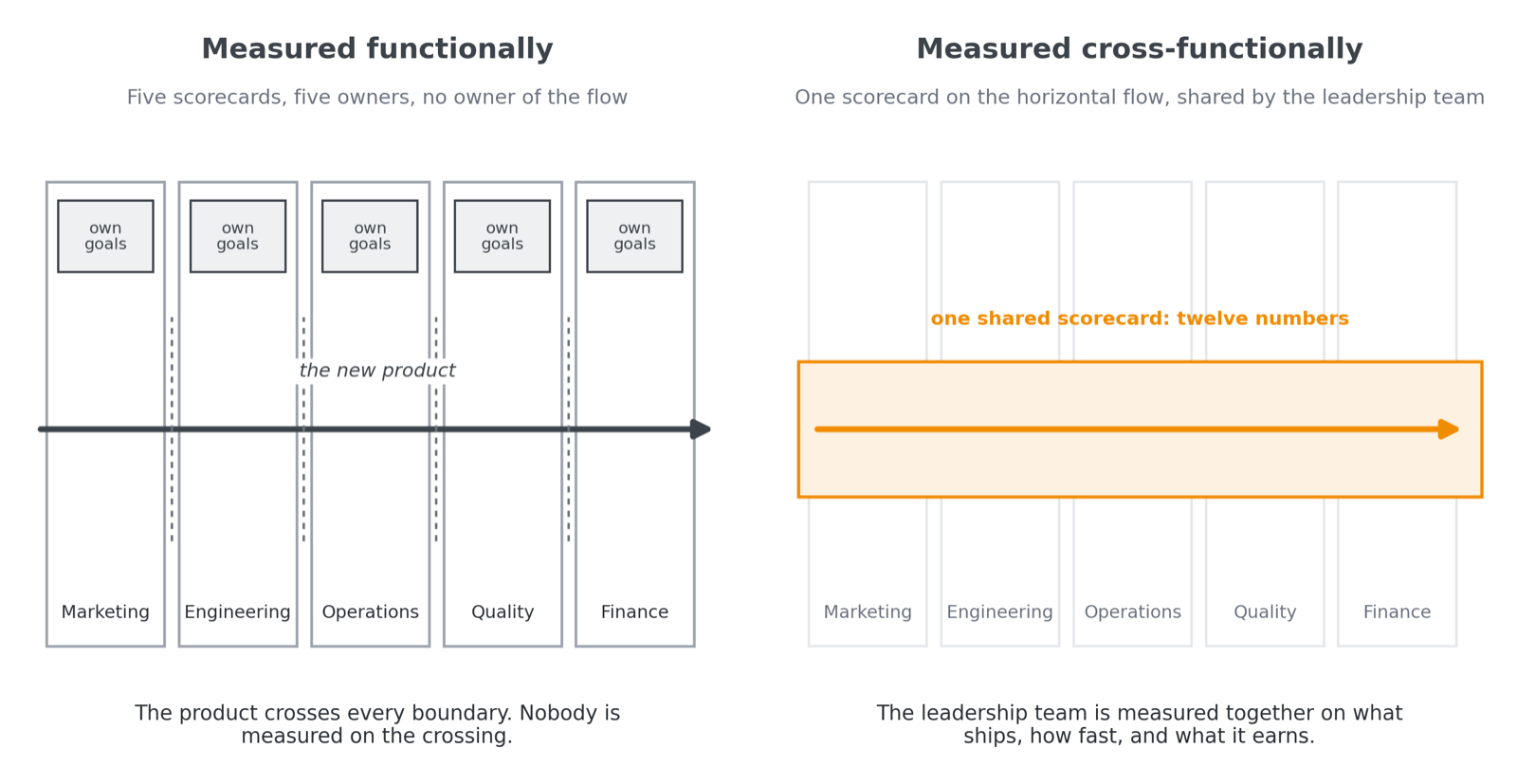
This is the short form of our white paper Ten numbers, which makes the fuller argument: measure the leadership team cross-functionally on the product engine, cap the set, and review it as one team. What you measure is what you get, as Kaplan and Norton put it more than thirty years ago. The two clocks decide when you get it, and whether you can still do anything about it.
Related reading: Targets and Trends, The Rhythm of Accountability, Aggregate, then Drill Down, Cost-of-Delay, Manage the Fuzzy Front End, Integrated Core Team, and What is the R.O.I. of fast decision-making?