You inherit a portfolio of new product development projects. The teams use FTTM methods. The schedules are accurate, refreshed weekly, and show the products landing on their target dates. What should you be asking? The instinct is to ask nothing. The schedules look healthy, the teams are practicing a disciplined method, and an executive who probes a green portfolio can feel like a micromanager. That instinct is wrong.
A green portfolio is a finding, not good news
A schedule that shows no gap to its target is the single most common signature of a schedule that has stopped telling the truth. Across lateralworks engagements since 1988, the programs that failed late almost always looked on track early. The difference between a genuinely healthy portfolio and one that has quietly stopped telling itself the truth is invisible in the artifacts and obvious in the conversation. A healthy portfolio can answer pointed questions about its gaps, its iterations, and its hard problems without flinching. The other kind cannot. The only way to tell them apart is to ask.
FTTM never builds a happy schedule. The distance between the customer target and the realistic finish is the engine of before-the-fact urgency: it justifies the resources, the decisions, and the parallel paths that close it. A schedule that matches the target on day one has usually been reverse-engineered from the answer. That is why the first thing an executive should do with a green portfolio is treat the absence of a gap as a finding, and start asking where it went.
Why accurate-looking schedules lie
Three well-studied mechanisms produce a green portfolio that is quietly off track. Confirmation bias: a product team that wants to be on schedule is superbly equipped to find evidence that it is, and schedules built from derivative-product templates go unchallenged because challenging them is uncomfortable and confirming them is not. The planning fallacy: in NPD it takes a specific, recognizable form — the schedule carries one pass through design, build, and test. One iteration everywhere is a prediction that nothing fails the first time. It has never come true. And the organizational mechanism, the one executives control most directly: real gaps stay hidden when surfacing them is dangerous. If the people who stepped out into the wind on past programs got blown away, the current teams saw it happen. The result is a portfolio where the gap is known three levels down and invisible at the top.
FTTM's answer to all three is the same: pull the pain forward. A problem exposed early is cheap; the same problem exposed in the eleventh hour is existential. The only variable leadership actually controls is the date of exposure. The questions below are the executive's tool for moving that date earlier.
Questions are how executives lead NPD
The tempting responses to untrustworthy schedules are structural: add a review gate, commission an audit, demand a recovery plan. Each of these tells the organization what to produce. None of them changes what the organization knows, and all of them teach the teams to manage the reviewer rather than the product. The instrument that works is older and cheaper: ask questions, in person, in front of the live schedule, and keep asking them on a cadence.
Asking works twice. First, it demonstrates involvement. Teams read executive attention accurately: a general manager who accepts a slide summary has communicated the required standard — produce good slides. A general manager who sits for an hour while a project leader walks the first five critical paths, task by task, has communicated something different: know your schedule, because I will. Second, and more valuable, asking teaches. Questions asked consistently get anticipated, and anticipated questions get institutionalized. A project leader who knows the monthly walk-through will ask where the learning cycles are starts asking their own engineers where the learning cycles are. Within two or three cycles the question has propagated down the organization and its answer has moved into the schedule, which is the goal. The executive's question list is a curriculum. Choose it deliberately.
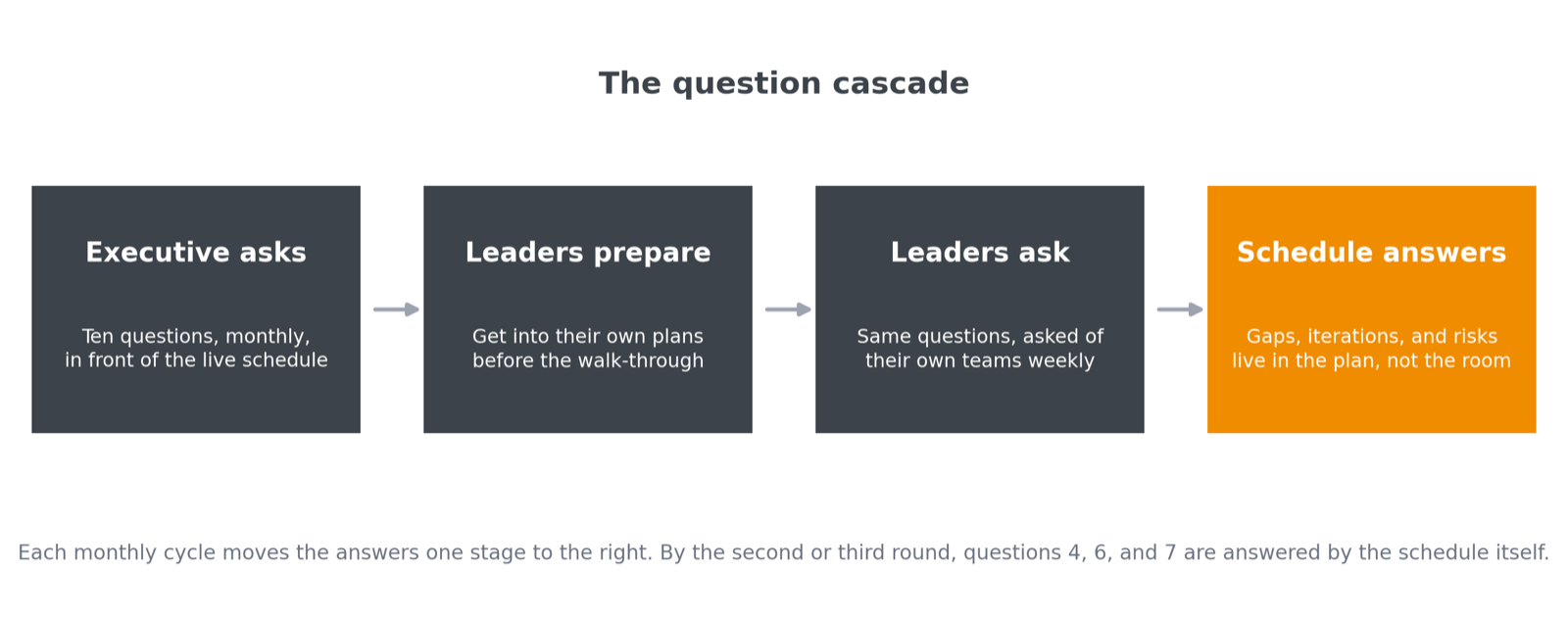
This is also how the executive escapes the micromanagement trap. The walk-through never tells a team how to solve its technical problems, and it never re-plans the project from the head of the table. It inspects whether the team is asking itself the right questions, and it models what those questions are.
Ten questions, one hour per project
The format matters as much as the questions. Have each project leader and their program manager present their schedule to you, live in the scheduling tool, walking the first five critical paths. The PM drives the tool; the leader answers the questions. One hour per project, no slides, schedule current as of that morning. Slides are where reality goes to be formatted; the live schedule is where it can be inspected. The answers matter less than the preparation the format forces: a leader who knows the walk-through is coming spends the preceding week inside their own plan, and that week surfaces more problems than the hour in the room.
- Where are we against the target date, plus or minus? Ask for the gap in weeks, and whether it lives on the schedule or only in the leader's head. Listen for: a number. "On track" without a number means the gap is hidden.
- Walk me through critical path #1, task by task. What is the driving task today, and who owns it? You are testing whether the leader can narrate their own plan. Listen for: whether the leader can narrate the path without the PM rescuing them.
- Now show me critical paths 2 through 5. How many days behind the longest path is each one, and which becomes #1 the moment the first is pulled in? Listen for: near-critical paths within days of the longest. Pull-in has to target the top three to five, not just the winner.
- Which tasks on these five paths assume everything works the first time? Where are the learning cycles, and how many does each hard problem carry? Listen for: one iteration everywhere. That is a prediction that nothing fails, and it has never come true.
- What are the top three technical problems between here and delivery? Rate each one easy, medium, or hard, then ask who is solving them and whether that is all those people do. Listen for: hard problems worked part-time by people carrying other jobs.
- Which problems will need more learning cycles than the schedule shows? Ask what the worst case looks like and whether a worst-case placeholder is in the plan. Listen for: open-loop unknowns — "no answer yet" appearing as no task in the plan.
- What are the top risks on these paths, and the mitigation for each? A mitigation with no owner, no date, and no trigger is a hope with paperwork. Listen for: mitigations with owners and dates. Intentions are not mitigations.
- What is the schedule trend: slipping or accelerating? The trend carries more information than the position. Listen for: active pull-in. A flat trend with no pull-ins means drift is being absorbed silently.
- What do you need that you are not getting? How many people, which skills, which decisions — then the question that changes the relationship: what can I remove for you today? Listen for: names and numbers. A vague call for "resources" is the excuse, not the constraint.
- Do you have confidence in the target date, and what would raise it? This closes the loop on question 1. Listen for: whether their confidence matches the gap they showed you an hour ago. If it does not, you now know which of the two answers was rehearsed.
What the questions surface
Run the walk-through across a portfolio and the same findings appear, in nearly the same order, in company after company. lateralworks has watched seven of them recur across engagements since 1988; the four below are the ones the questions expose first.
Leaders who ask what their role is. Project leaders who cannot narrate their own plan, and who report missing skills without a plan to acquire them. The executive action: tell each leader directly that they own the outcome, and judge them on whether they find and fix what is missing rather than on how well they report it.
The unmanaged critical 10%. Each project has a few research-grade problems holding up the 90% the teams have done a hundred times, and those problems are being worked part-time by experts split across teams and meetings. The executive action: isolate the 10% into its own project-managed schedule with a dedicated core team, give them everything they ask for, and run their plan on twice-weekly refreshes with executive visibility. Solutions come from focused people, not from large meetings.
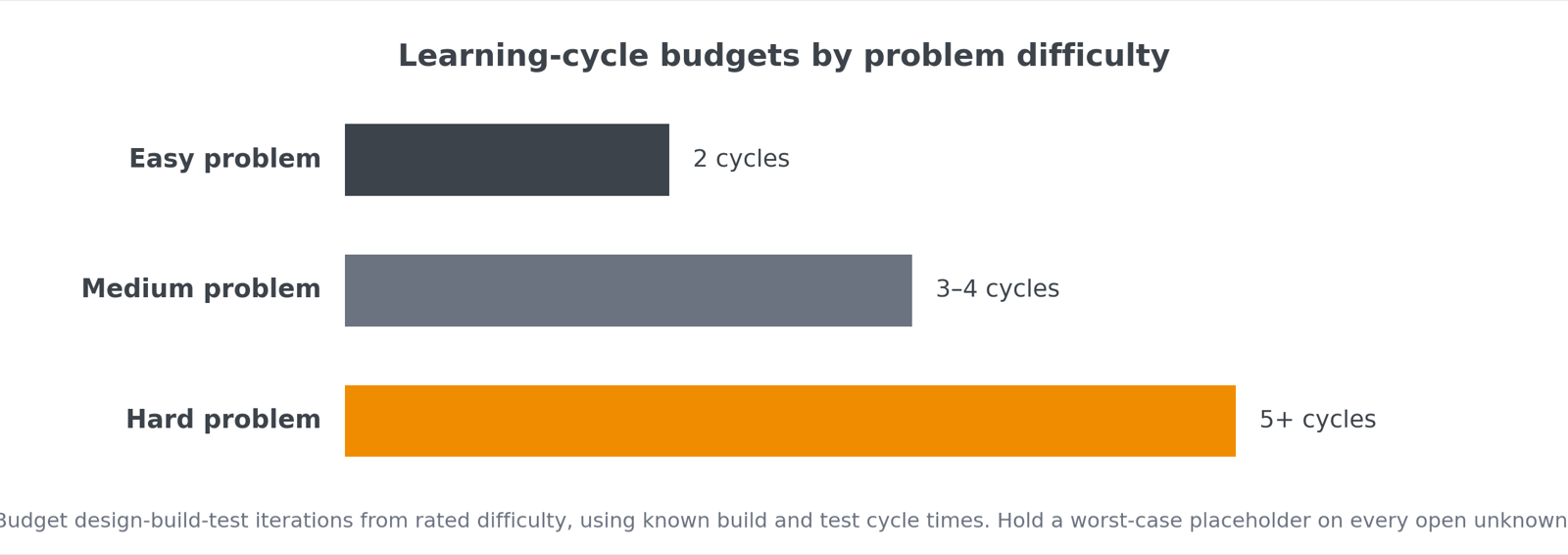
Schedules with one learning cycle. Optimistic new-product-introduction templates applied to new-product-development work, with first-of-a-kind iteration never planned in. The fix is a planning discipline, not a personality change: rate each technical problem easy, medium, or hard, budget cycles accordingly, and put a worst-case placeholder on every open unknown so the schedule stays closed-loop.
No safe way to surface bad news. Every question on the list depends on this one being fixed, and only the executive can fix it. The first reaction to bad news determines how much bad news reaches you afterward. The executive action: publicly back the first person who surfaces an ugly gap, reward gap-surfacing in reviews, and say it out loud, often — bad news early is good news.
Run it as a rhythm, not an event
A single walk-through produces a good meeting. A monthly walk-through produces a different organization. Repeat the ten questions with each project on a fixed cadence, and hold the schedule-currency expectation between reviews: schedules refreshed weekly, current as of a fixed day, as a standing and non-negotiable norm. By the second round, the answers to questions 4, 6, and 7 should be in the schedule rather than in the room. When a leader answers every question from their own plan without looking at the PM, the pain has been pulled forward and you are no longer flying without instruments.
The first honest walk-through usually produces a gap measured in months, and what you do next sets the tone for every review that follows. Thank the leader, publicly and specifically. Then get to work on the gap: fund the named resource asks fast, make the unmade decisions, and authorize the parallel paths. Accountability without provisioning is unfair, and provisioning without accountability is charity. FTTM does both, in strict order: remove every named excuse in writing, then hold delivery accountability with no exceptions.
Start this week. Ask questions 1 and 4 of every project leader in the portfolio: where are we against the target, and which tasks assume everything works the first time? Put the first full walk-through on the calendar. Everything else follows from seeing the true gap.
Downloads
The full paper and its two companion briefings: