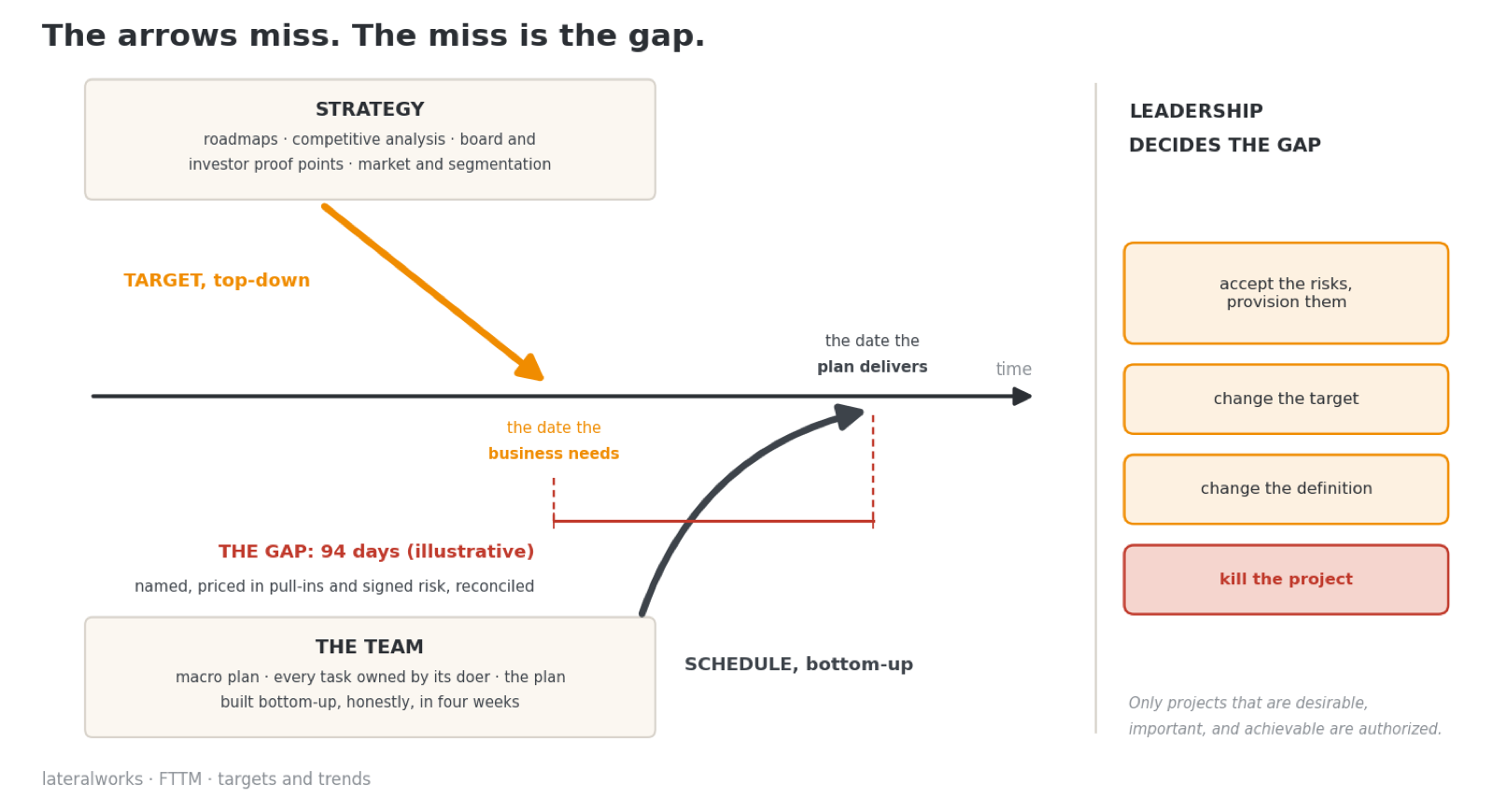
Not long ago, in the run-up to a client’s strategy workshop, a planning worksheet went out asking the project teams to fill in their target dates. One column heading, and the whole operating model inverted. Targets are top-down. Schedules are bottom-up. You use a process to reconcile the gap between them. It is as simple as that, and nearly every planning dysfunction we see in executive teams is one of those three motions running in the wrong direction.
Targets come down
Targets do not come from PMs or development teams. They come from your strategy, and your strategy comes from your product roadmap, your technology roadmaps, competitive analysis, the proof points you have committed to your board and investors, and your market and segmentation analysis. We covered what makes a target legitimate in a companion article: external, meaningful, difficult but feasible, set once. This article is about direction of flow, and the flow is downward, because strategy is owned above the teams and is developed without constraints. It is built from external factors and your internal goals. Strategy is not created from what you can do; it is created from what you want.
That is also why predicted finish dates do not belong in the strategy room. Keep them in your back pocket. Develop the strategy first, unconstrained, and then bring the predictions out as the comparison that reveals the gap. A strategy shaped in advance by what the teams believe they can do is not a strategy; it is a forecast wearing one’s clothes.
Schedules come up
The team’s job is not to set the date. The team’s job is to build the plan that delivers it: a macro plan first, then a full schedule with every task owned by the person doing the work, per the best practices of fast teams, and a full bottom-up baseline takes four weeks, not a quarter. That bottom-up construction is what makes the schedule honest, and an honest estimate is an asset even when it lands more than a year from your target, because a fiction cannot be optimized. If the plan cannot hit the target, the team’s obligation is threefold: show the schedule gap in days, propose the pull-ins that would close it, and price those pull-ins in signed risk. What the team never does is quietly adjust the target to match the plan, and what you never do is quietly reject the plan for missing the target. Both moves destroy the information the system exists to produce.
The reconciliation is the management system
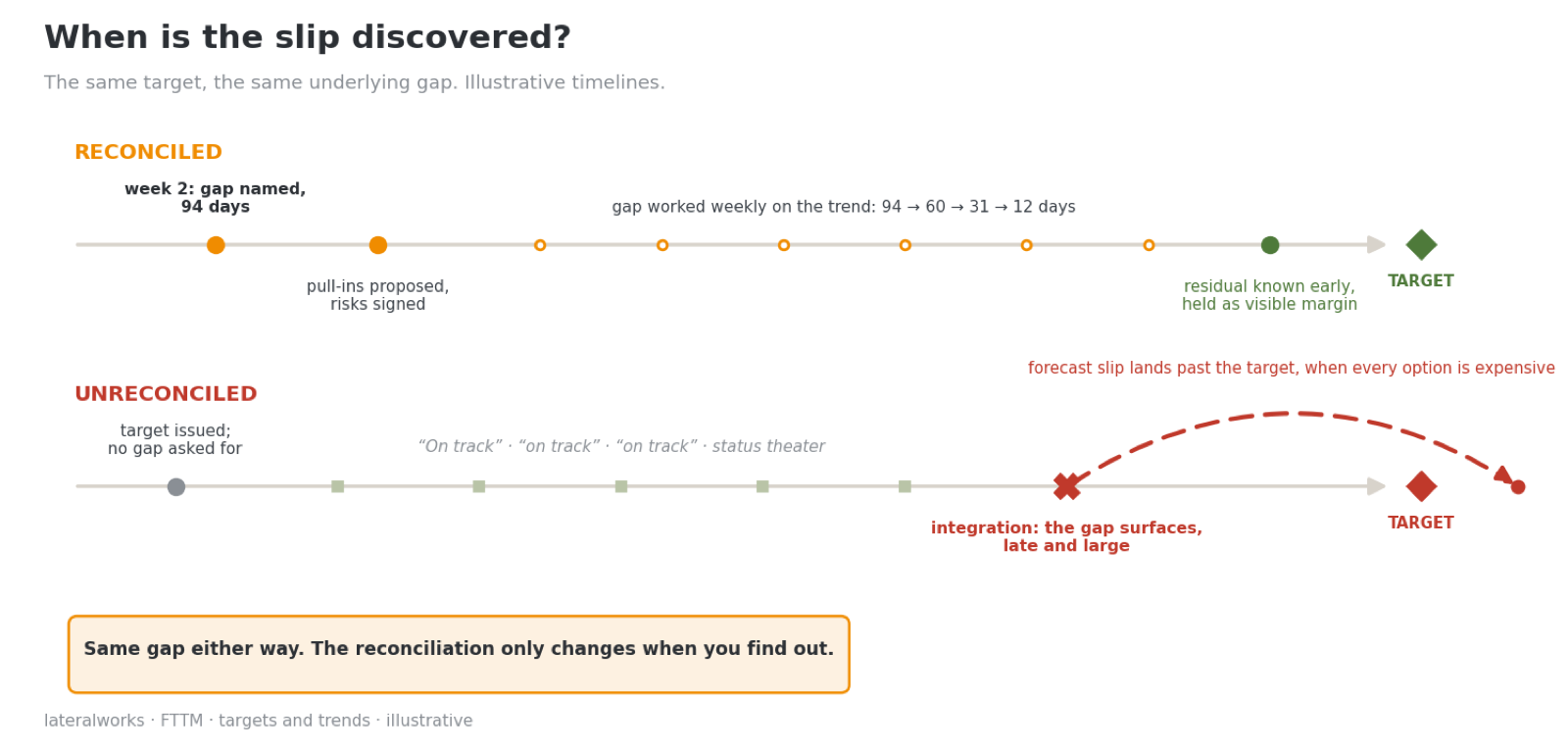
With the gap on the table, you have real options, and they are yours, not the team’s: accept the risks and provision them, change the target, change the definition of what is being built, or kill the project. That decision list is the whole point. The lean world has run this loop for decades as catchball, where hoshin planning becomes a top-down and bottom-up dialogue between senior managers and project teams about the resources and time needed to reach the targets, and the Lean Enterprise Institute’s definition ends exactly where this article does: the objective is that only projects that are desirable, important, and achievable are authorized. At Toyota, catchball is not an annual ceremony; it happens continuously, which is what the weekly trend gives you: a reconciliation that never closes, read against a target that never moves. And a gap that closes past zero becomes margin, held in the open, where it protects the date instead of padding the tasks.
The unreconciled target
Now the part that belongs in front of every CEO, because the failure is executive-made. Issue the top-down target and skip the reconciliation, and here is what happens, every time we have seen it. The team salutes. The gap does not disappear; it goes underground, into unpriced risk, unexamined assumptions, and a schedule that becomes a compliance document instead of a plan. Nobody proposes pull-ins, because pull-ins acknowledge a gap that officially does not exist. Then the slip arrives, late and large, usually at integration, when every option left is expensive. This is the most common cause of major slips and project failures we see, and the research agrees from both directions: stretch-goal studies find that targets without the capacity conversation disorganize the very companies most tempted to issue them, and PMI’s benchmark work prices the failure at 109 million dollars lost per billion spent. The target was never the problem. The missing step was. Gloria Steinem put the human mechanics of this in one line:
“The truth will set you free, but first it will piss you off.”
Gloria Steinem, The Truth Will Set You Free, But First It Will Piss You Off!, 2019
The gap is that truth. Named in week two, it is infuriating and workable. Discovered at integration, it is neither.
Kill it before it kills the quarter
Which brings the hardest decision on the list. If the gap cannot be reconciled, if the pull-ins are exhausted, the risks unacceptable, the target immovable because the market set it, and the definition already cut to the bone, then kill the project, before it consumes more resources and time. Killing early is cheap and is your strategy working as designed; killing late is a write-off with a headcount. A project that cannot be reconciled is not a project. It is a liability with a burn rate, and every week it runs, it starves the projects that can win. The discipline is in our published best practices, and it is the discipline the reconciliation exists to enforce: authorize only what is desirable, important, and achievable, and free the people on everything else to work on what is.
Your role in this system is three motions. Set the targets from strategy, and only from strategy. Demand the bottom-up schedule and the gap, stated in days, with priced pull-ins. Then decide: provision, retarget, redefine, or kill. Targets are top-down. Schedules are bottom-up. The process reconciles the gap. It is as simple as that.
References: Lean Enterprise Institute, Strategy Deployment (hoshin kanri), Lean Lexicon. Ehrenfeld, Lean Roundup: Hoshin Kanri As a Strategic Force, Lean Enterprise Institute. Sitkin, Miller, and See, “The Stretch Goal Paradox,” Harvard Business Review, 2017. PMI, Pulse of the Profession: The High Cost of Low Performance, 2014. Steinem, The Truth Will Set You Free, But First It Will Piss You Off!, 2019.
Related reading: Where targets come from, Bimodal thinking, Schedule Gap, Targets and Trends, No Risks = No Schedule, Who owns the strategy?, Mapping strategy to execution, and Pull in before you slip.