The day we published Where targets come from, an executive on a client program sent back the perfect question. His products power custom chips that his customers design themselves. Those chips go into systems being reinvented every generation; power is growing five times generation over generation. So his customers are solving their own hard technical problems, and when they hit an obstacle, their schedules move. A slip is rarely announced and almost never shared formally. The news arrives in pieces. His question: if we are executing to a schedule and the customer slips a quarter or two, should we move the target or keep marching to plan?
The question is perfect because it puts two of our own rules in collision. A target must be customer-driven, tied to something real outside the team, or nobody makes a stretch effort for it. And a target is set once, a contract between the team and the company, because everything a target is for depends on it standing still. So what happens when the something real moves?
Hold the window, not the point
The answer we gave is the target window. Put the customer’s new estimate at the far edge of the window and the aggressive team target at the near edge, which is usually the date the team was already marching to. The company commits to the customer’s date. The team keeps planning and pulling in against the aggressive one. The space between the edges is margin, held in the open, the same honest structure as the stretch-and-commit pair.
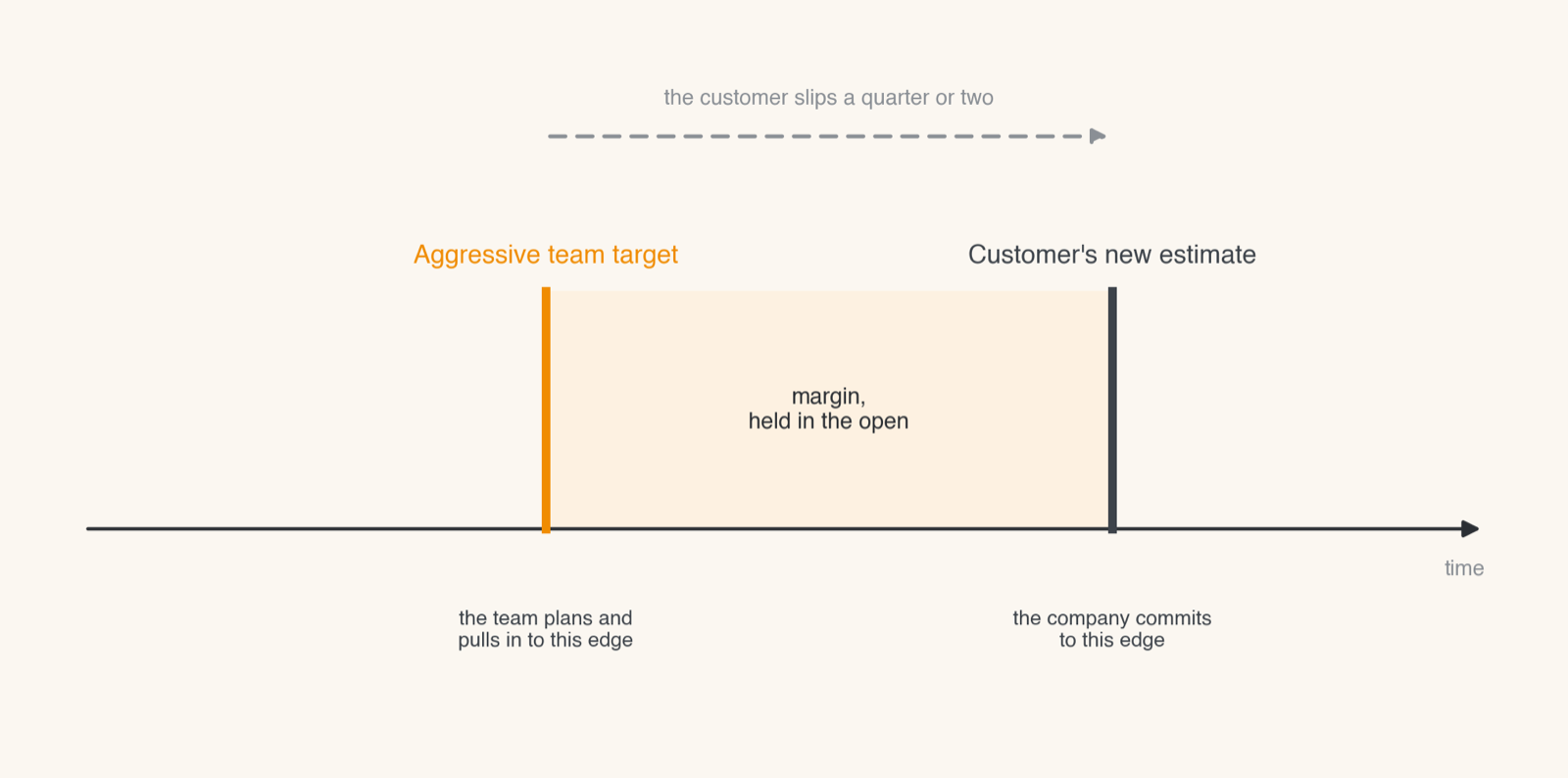
Keep the team at the near edge for three reasons. First, a slip that arrives in pieces is stale by the time it assembles. The date that drifted out can drift again, in either direction, and the estimate the customer gave you is a guess wrapped in caution. Second, this industry is famous for putting on the brakes and then quickly pressing the accelerator. It drives with both feet on the pedals. The customer who slowed down in August can hand you a more aggressive date in November, and they will not apologize for it. Third, Parkinson’s law is undefeated: work expands to fill the time available for its completion. Relax the target and the team spends the slip. Hold it and the team banks it. Banked time is yours when the accelerator comes back down. Spent time is gone.
There is one honest exception. If the near edge is truly unachievable given the unknowns, holding it makes the target a fiction, and teams stop jumping for fictions. That call belongs to leadership. Make it once, in the open, and set the new window against the best information you have. What you may not do is let the target drift out a week at a time until nobody remembers what the date was for.
Why you are guessing at all
Now look at the uncomfortable part of the question: the news arrives in pieces. That is not a data problem. It is a relationship problem. A transactional customer rarely tells you their real timing. They play the game of saying they need it sooner than they really do, assuming you will slip, so that it arrives just in time. You pad your promise. They pad their need. Both sides plan against numbers both sides know are wrong and call it planning. A transactional customer gives you a date. A partner gives you the truth.
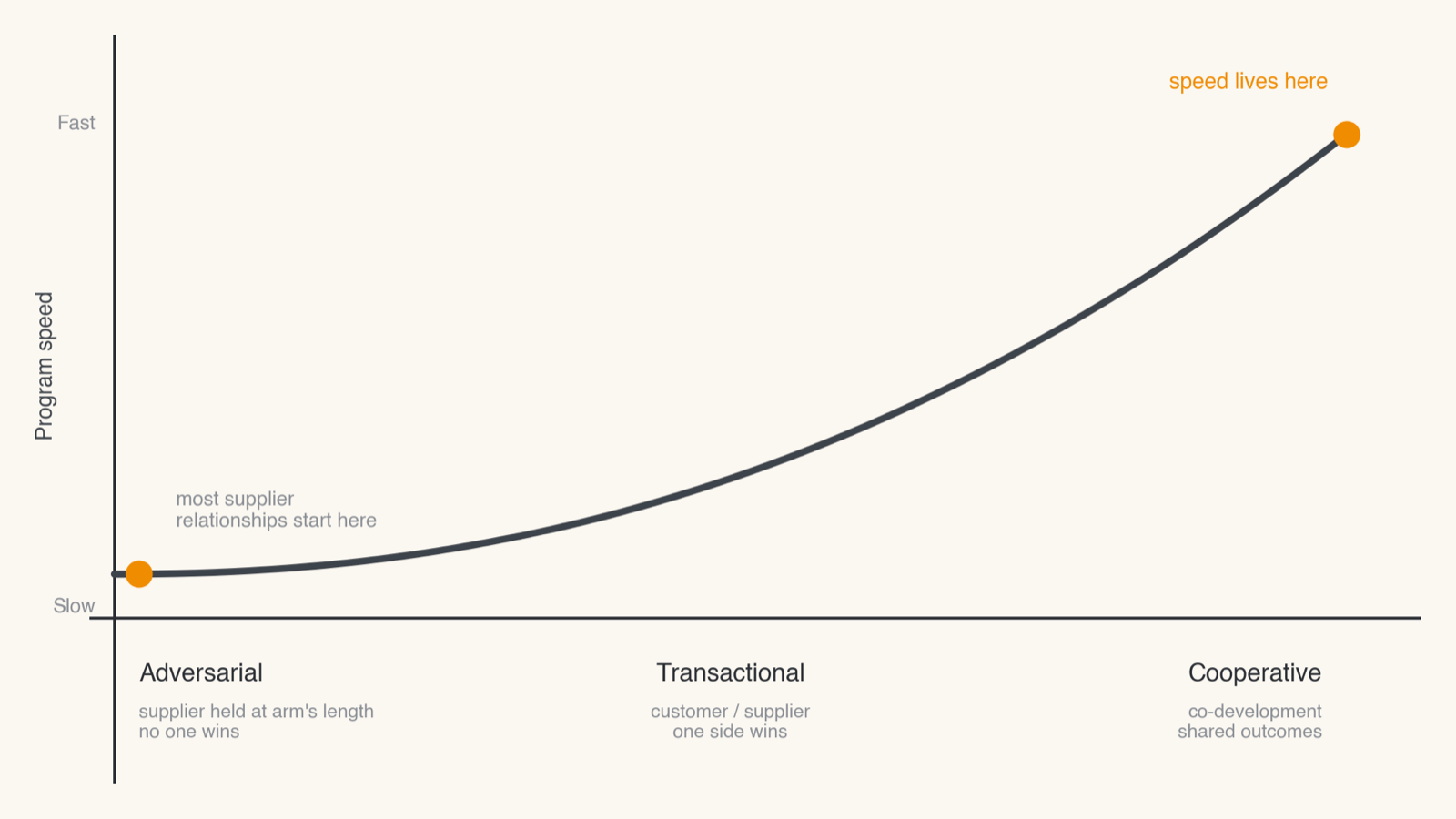
Supplier relationships run on a continuum. At one end is adversarial, where no one wins. In the middle is transactional, where one side wins. At the far end is cooperative, where the two development programs run as one and the outcomes are shared. Speed lives at the cooperative end, because that is the only place the dates being exchanged are real.
The wide lens
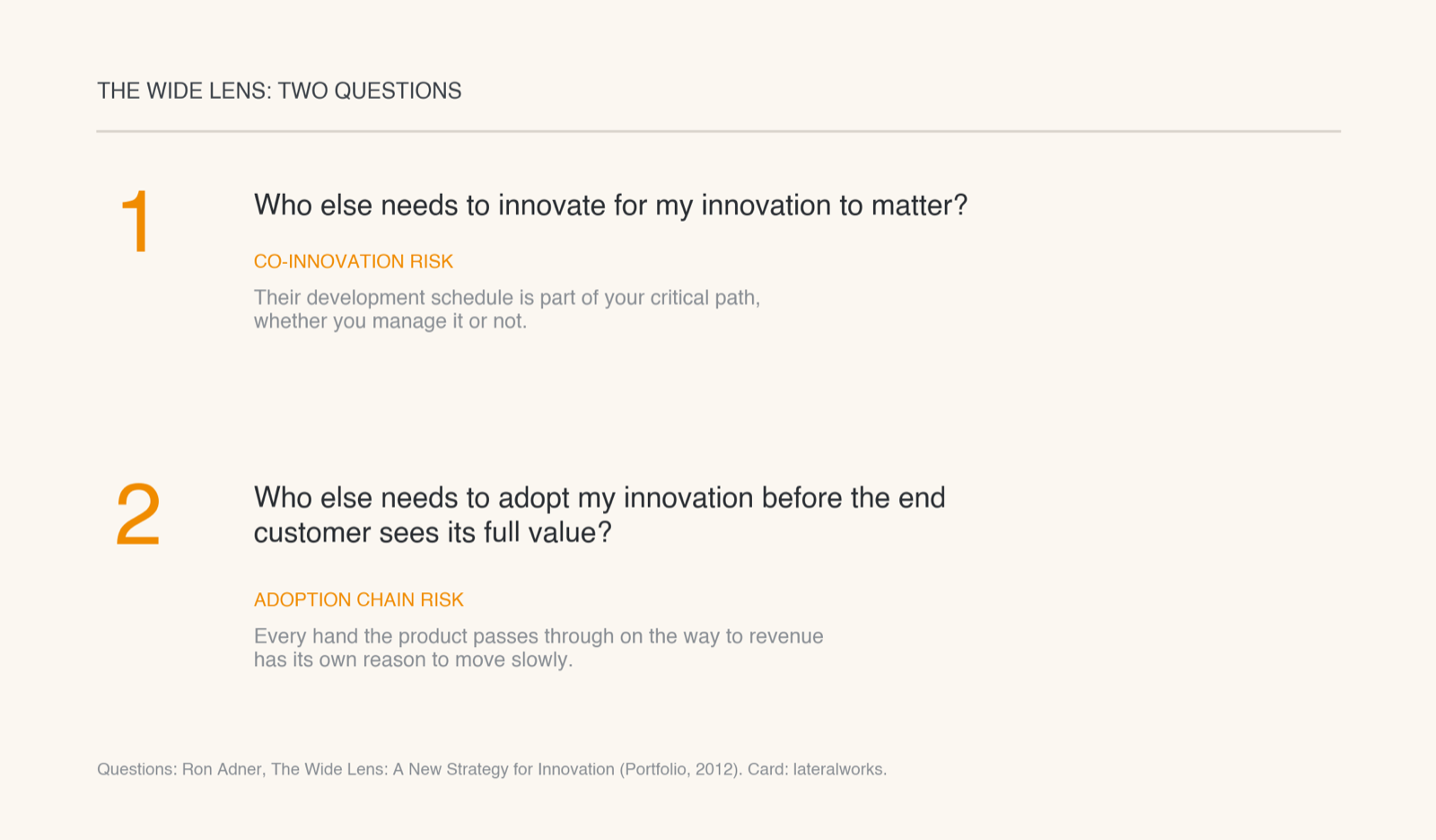
Ron Adner, who teaches strategy at Dartmouth’s Tuck School of Business, gave this idea its best modern treatment in The Wide Lens: A New Strategy for Innovation (Portfolio, 2012). Innovations fail, he shows, not only when the team fails to deliver, but when the ecosystem around the innovation is not ready to receive it. He asks two questions. Who else needs to innovate for my innovation to matter? And who else needs to adopt my innovation before the end customer sees its full value? He names the failures co-innovation risk and adoption chain risk. We would name them what we always name them: dependencies you are not managing. Answer his two questions and you know whose development schedule is on your critical path and whose adoption stands between you and revenue. That is your execution focus, and it is the exact timing you were trying to guess. The book belongs on every product boss’s reading list.
Adner is not alone, and the idea is older than the book. James Moore carried the word ecosystem from biology into business in his 1993 Harvard Business Review essay Predators and Prey: companies do not evolve alone, they co-evolve with suppliers and customers. Clark and Fujimoto’s Product Development Performance (1991), the classic study of the world auto industry, found that suppliers integrated into the customer’s development, instead of held at arm’s length, were one large reason Japanese automakers put cars on the road faster. The idea keeps getting rediscovered because it keeps being true. Part of your program’s speed is set outside your program.
We have run this play
In 1993, Sony entered a console market owned by Nintendo and Sega with a plan that depended on a 500,000-gate single-die ASIC, a five-times leap over anything LSI Logic had shipped. The relationship could have stayed transactional: take the spec, quote a date, pad it, hope. Instead we moved it to the cooperative end and ran a true co-development. LSI gave Sony early models, libraries, and very early engineering samples, and the two companies worked one plan. Engineering samples shipped twelve months ahead of Sony’s schedule. Sony used that year to accelerate past the incumbents and establish the PlayStation as the leader of a new category, and the program roughly doubled LSI Logic in a single year. The customer’s acceleration became the supplier’s growth. The full story is in the case study.
Take the guessing out
So the full answer to the executive’s question runs in two time frames. This quarter: hold the window. Commit to the customer’s new date, keep the team marching on the aggressive edge, and bank the difference. For good: change the relationship, because a target you have to guess at is a symptom, not a condition of life. Ask Adner’s two questions about the customer your growth depends on. Then move that one relationship one step up the continuum: share the schedule, share the early samples, share the risk. When both programs work to the same goal, the nonsense dates stop, on both sides. You do not synchronize with a customer by asking for their dates. You synchronize by sharing a schedule.
Related reading: Where targets come from, Targets and Trends, Schedule Gap, The Weekly Schedule Refresh, Positive vs Negative Buffer (i.e. Margin), Ten numbers on two clocks, Integrated Core Team, and The FTTM execution system.