In May 2014, Admiral William H. McRaven told the University of Texas graduating class that if you want to change the world, start off by making your bed. The point was never tidiness. It was agency: complete one small task you fully control, first thing every morning, and you carry proof of accomplishment into everything that follows. lateralworks published a full paper on what that lesson means for development programs. This article is about the one argument in it that changes teams: the weekly schedule refresh is the rhythm of accountability, and the rhythm matters more than anything discussed inside it.
The meeting that never gets canceled
The refresh, which teams also call the pull-in meeting, is a standing discipline. Same day, same time, every week, every task owner on or near the critical path reports an honest estimate, the schedule is updated live, the critical path is recalculated, and the core team leaves with a specific pull-in decision: an option, an owner, a date. The mechanics compress into a two-day rhythm: the update report goes out on Day 1, and on Day 2 the updates are imported, the critical path is recalculated, the wigglechart gets its weekly point, and the pull-in meeting decides. The schedule update and the wigglechart run on the same day deliberately, so the trend point and the meeting always describe the same baseline. The core team's share of the whole ceremony is one forty-minute meeting.
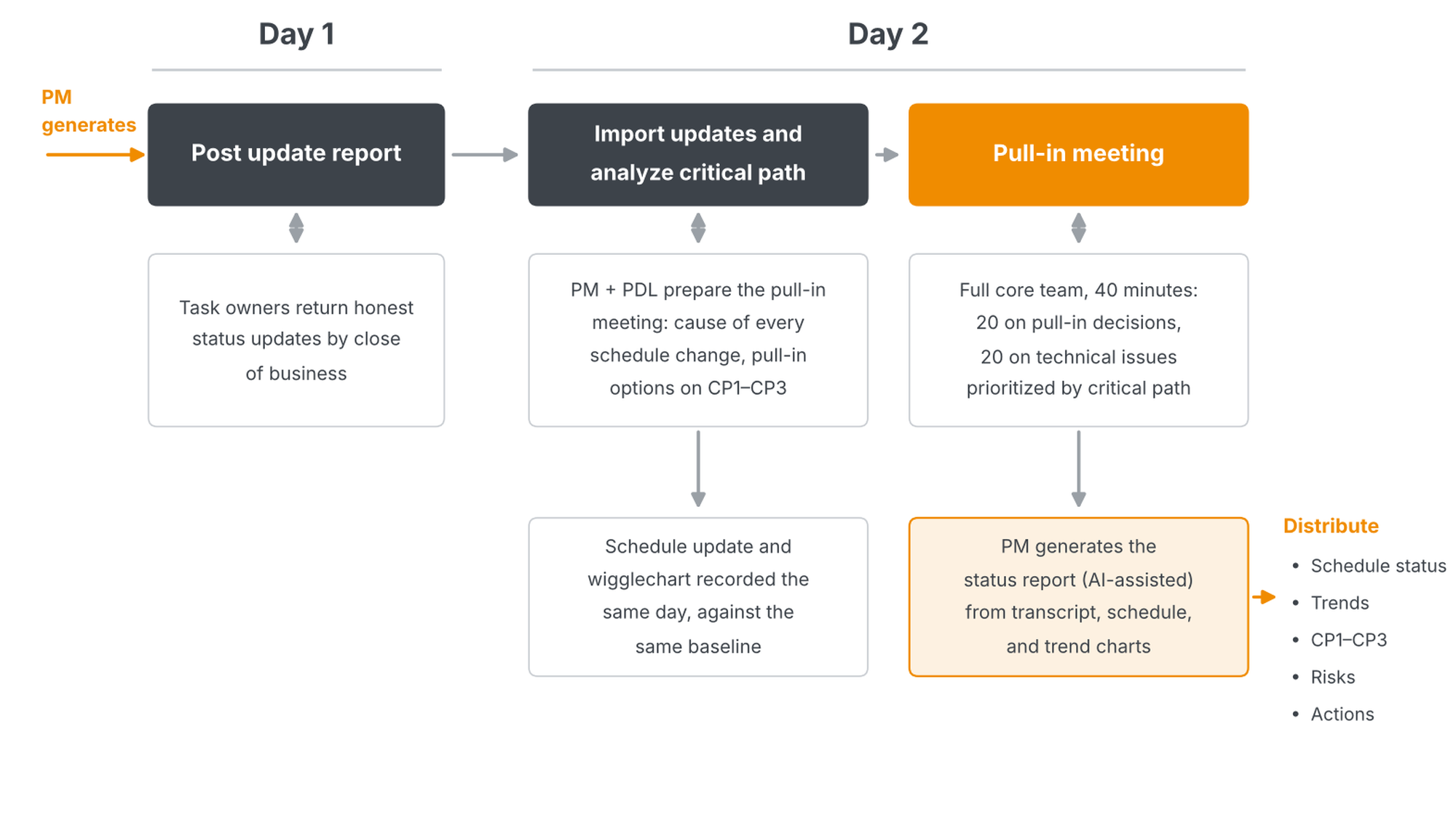
The rule that makes it work is absolute.
The standing rule
The refresh never gets canceled. It is the only meeting in the company that never gets overruled; even the CEO does not displace it. Find a way, every week: a trained backup runs it, it moves a day, or the updates get collected and the report goes out anyway. The team covers for one another. The stability of this meeting is the first step in stability on the project.
That is not rigidity for its own sake. On one three-year joint development program spanning hundreds of people across multiple companies, the refresh was missed exactly once in three years, on Christmas Day. The paper's point about that record is the right one: it was not heroism. It was a made bed, three years running.
Accountability is the mechanism
Why does a forty-minute meeting change a program? Because of what happens in the six days before it. Each core team member knows that on refresh day they will report their progress back to their fellow team members, in public, against the dates they gave last week. Not to a manager in a private status call. To their peers, who are counting on the handoff. The question each owner answers is the simplest one in program management: did the work go as I said it would?
Knowing that question is coming changes behavior all week. Commitments made to teammates become personal in a way commitments made up the chain never do; the 4 Disciplines of Execution literature calls this exact structure a cadence of accountability, and builds its fourth discipline on it. Estimates get more careful, because the person who gave one defends it seven days later. Blockers get raised early, because raising one on day two beats explaining one on day seven. The schedule stops being the program manager's document and becomes the team's scoreboard.
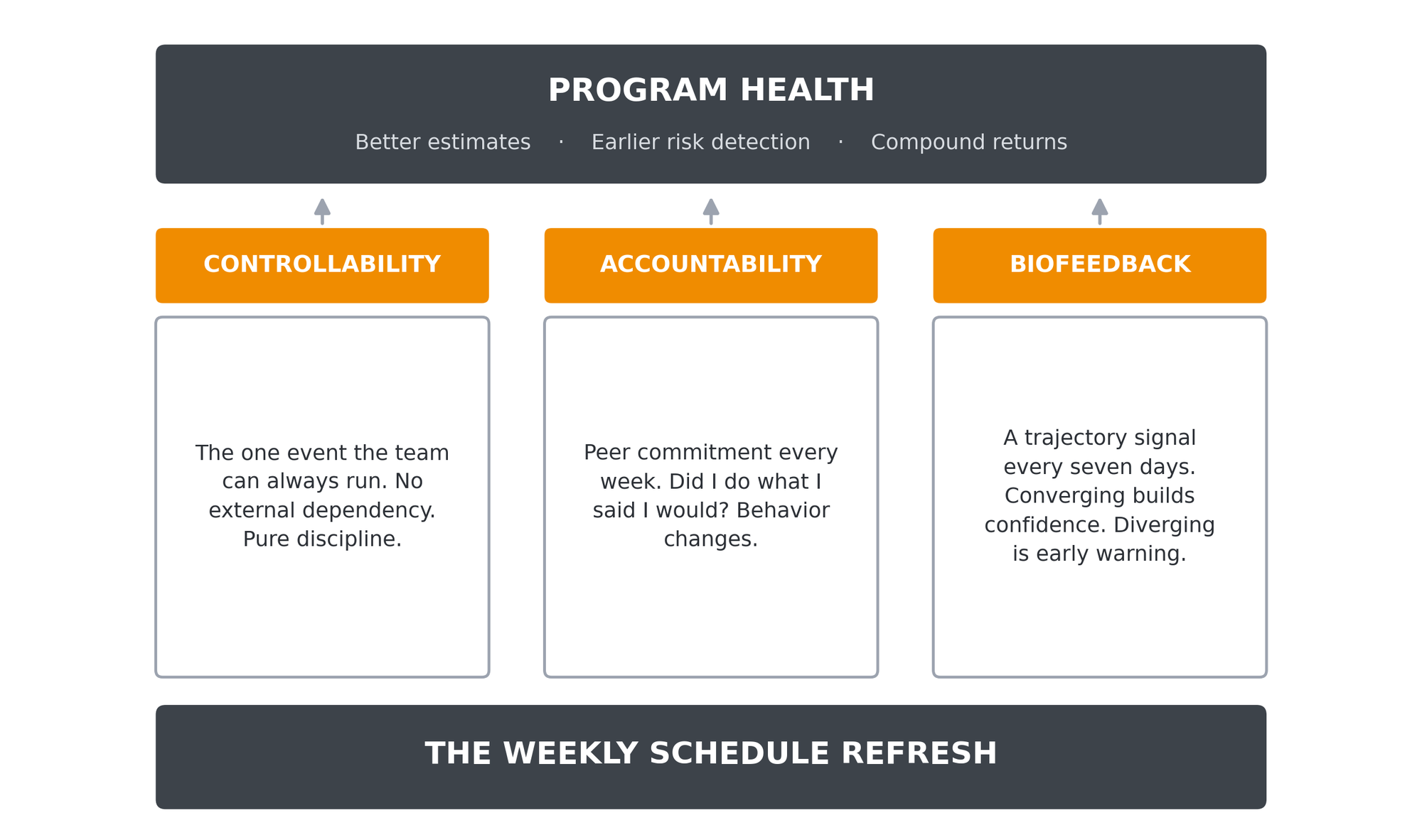
Then the compounding starts. When each individual is accountable to the team, week after week, the team eventually takes collective accountability for the project outcome. The meeting stops ending with a status ("we are three weeks behind") and starts ending with a decision: the pull-in the team chose, the owner, the date. That transition, from reporting the schedule to attacking it, is the whole difference between a status meeting and a refresh.
The first predictable thing
Every development program runs inside a fog of things the team cannot control: supplier slips, silicon bugs, specification changes, resource pulls. The refresh is the one event on the program whose existence depends only on the team's own discipline. No supplier can slip it and no customer can cancel it; it happens because the team decides it does. It is the first predictable thing on the project, and the team completely controls it.
That is exactly McRaven's bed. The habit research the paper cites adds two practical notes: missing one week does not reset the discipline, so a holiday does not kill the habit, but moving the meeting around the calendar does, because habits only form in a consistent context. Fix the day and the hour, and defend them.
And like the bed, the refresh is the start of more. Each week the team practices honest estimating, it estimates better. Each week it reviews the critical path, it spots risk earlier. Each week it watches the trend, it builds an intuition for program health that no monthly review can match. The paper puts it in one line: cadence is the practice that keeps the other nine honest.
Start small. Fix the day and the time. Run the first refresh even if the analysis is thin, and run it again next week. Make your bed.
The full paper, with the behavioral science, the operating mechanics, the five mandatory elements and a complete worked example of the weekly report: Make your bed. Related on lateralworks: The exception report and The FTTM execution system.