Last week we published the cycle time metric study: eleven schedules against a 12-month model, with every gap concentrated in Define. That told us where the portfolio’s time goes. This companion asks the next question: put the ten product schedules’ critical chains side by side, and what do they share? The answer changes the optimization problem entirely. The portfolio does not have ten critical paths. It has one, copied, with a different front end in front of it. You do not optimize ten schedules. You optimize one template, and six ship dates move at once.
The analysis is Claude’s, run on the same extracted Microsoft Project files as the cycle time study. It mapped the open critical chain of each schedule, the driving path through the work that remains, onto sixteen steps the schedules share, then ranked the steps by the critical-chain days they carry across the portfolio. Goldratt gave the discipline its vocabulary in 1997; the extracted schedules give it evidence, task by task, from the same files the teams maintain every week.
One step carries 28 percent of the critical calendar
Tooling, from the tooling order through fabrication to final tool approval, sits on all ten chains at 114 to 226 days, a median of 130, and sums to 1,439 of the portfolio’s 5,232 critical-chain days: 28 percent of the portfolio’s critical calendar in one step. The next largest, mechanical design, carries 10 percent. Nothing else reaches 8. Whatever the contract manufacturer does with its tooling lead time moves every ship date in the portfolio at once.
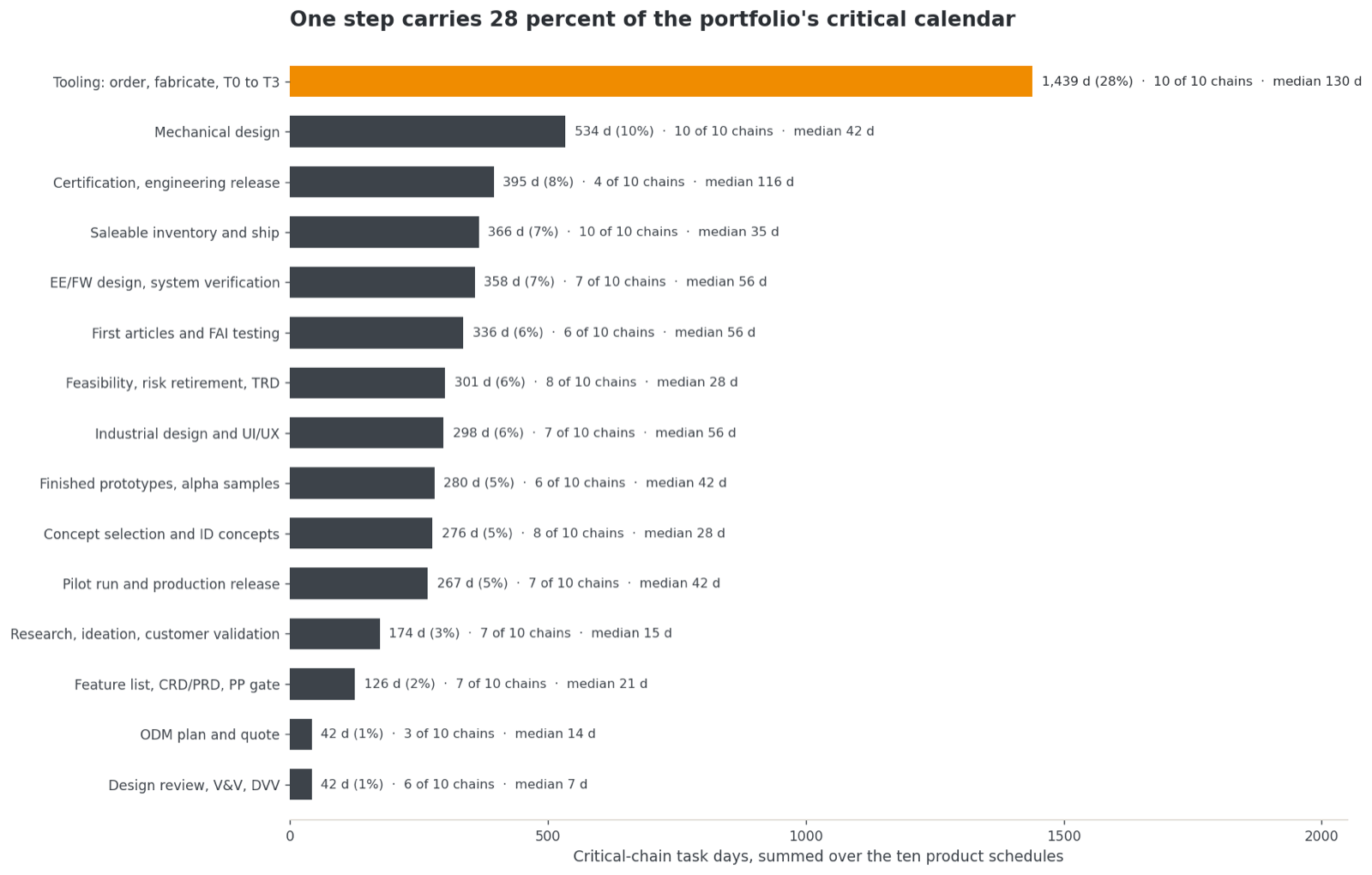
Here is the strategic read on that number. Tooling duration is the ODM’s number, and the ODM has quoted it the same way ten times. You do not attack a 28 percent step by asking the supplier to work faster. You attack it with the levers you own, which sit upstream of it and beside it.
The same spine, fed two different ways
The chains run through the same eight steps in the same order: mechanical design, EE/FW design, finished prototypes, tooling, first articles, design review, pilot run, saleable inventory. In the six template plans the durations are identical to the day. What differs is what feeds tooling. The template plans wait for a 42-day finished-prototype build before ordering tools. The gated programs order tooling the day mechanical design completes and carry a 14-day recut, a budgeted second correction of the tool, inside the tooling block. The template plans therefore hold 63 to 91 days on the chain ahead of tooling that the gated programs run in parallel with it.
The first lever: order tooling at mechanical design complete. The completed programs have already paid for the evidence: the cohort that tooled in development ran its scale-up in 69 days against 195. Budget the recut as a signed risk, and every template plan gets its 63 to 91 days back. It is the only lever that touches the 28 percent step without asking the ODM to work faster.
The front end is long because it is serial, not because anything in it is big
The cycle time study showed Define running 2.7 to 4.8 months against a one-month metric, and the chain analysis shows why. Research, concept selection, requirements, feasibility, and the ODM quote each carry a median of 14 to 28 days, and each one feeds the next. None of them is large. Together they are 17 percent of the chain days and the whole of the Define overrun, because nothing in the front end runs in parallel. Most of those dependencies are habit. ID concepts, customer validation, and the capability test do not depend on one another; only the CRD/PRD does.
The second lever: run the front end in parallel. Run the independent studies together and Define lands at the TARGET the plans already carry. One plan has proven the move: Hallasan ran one front-end step alongside the rest and took 54 days off its ship date in a single edit. That is the challenge process working on dependencies instead of durations.
A 140-day tail that nobody overlaps
After tooling, every template plan runs the same serial tail: first article units, first article inspection and V&V, design review, pilot run and V&V, saleable inventory, ship. Six steps, 140 days, each starting the day the last one ends, identical across all six template plans. Certification is the only downstream work any plan runs in parallel.
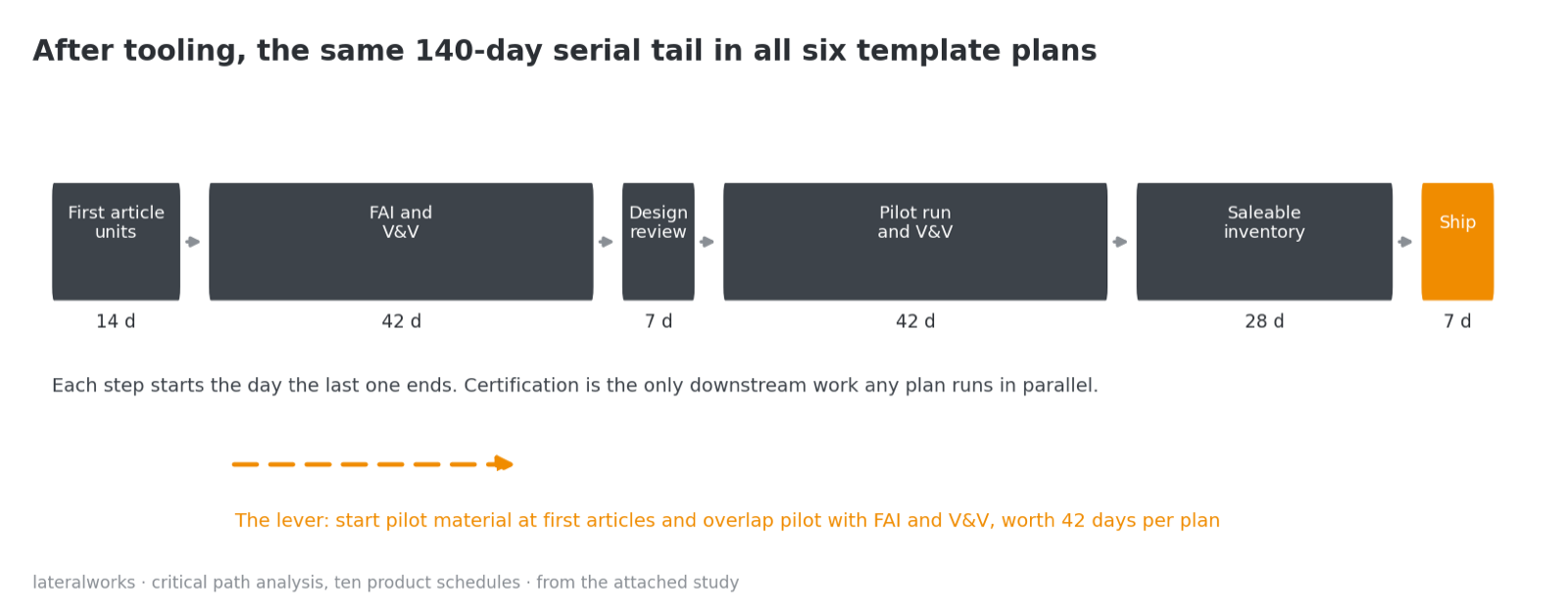
The third lever: overlap the tail, with the ODM. The fastest program already shows the way: Everest starts pilot material preparation at first articles, and pilot production can overlap first article inspection and V&V once the first articles pass. That is a 42-day lever on every template plan. It needs the ODM’s agreement on when it will commit pilot material, which is why it is the second move, not the first. The first two levers are yours alone.
Fix the template, not ten plans
Because the six template plans share one downstream block to the day, a change made in the template reaches six ship dates. This is also why the cycle time study found the back half of every plan already at the metric: the downstream block is one piece of engineering, built with the ODM, reused six times. The sameness that made the portfolio slow in one place makes it fast to fix everywhere.
The arithmetic sits on one page of the attached analysis. Hold Define to its own TARGET by running the front end in parallel, order tooling at mechanical design complete, and every template plan ships inside its committed window with two to four months to spare. That margin is the contingency a single committed forecast should carry, and the tail overlap is the reserve behind it.
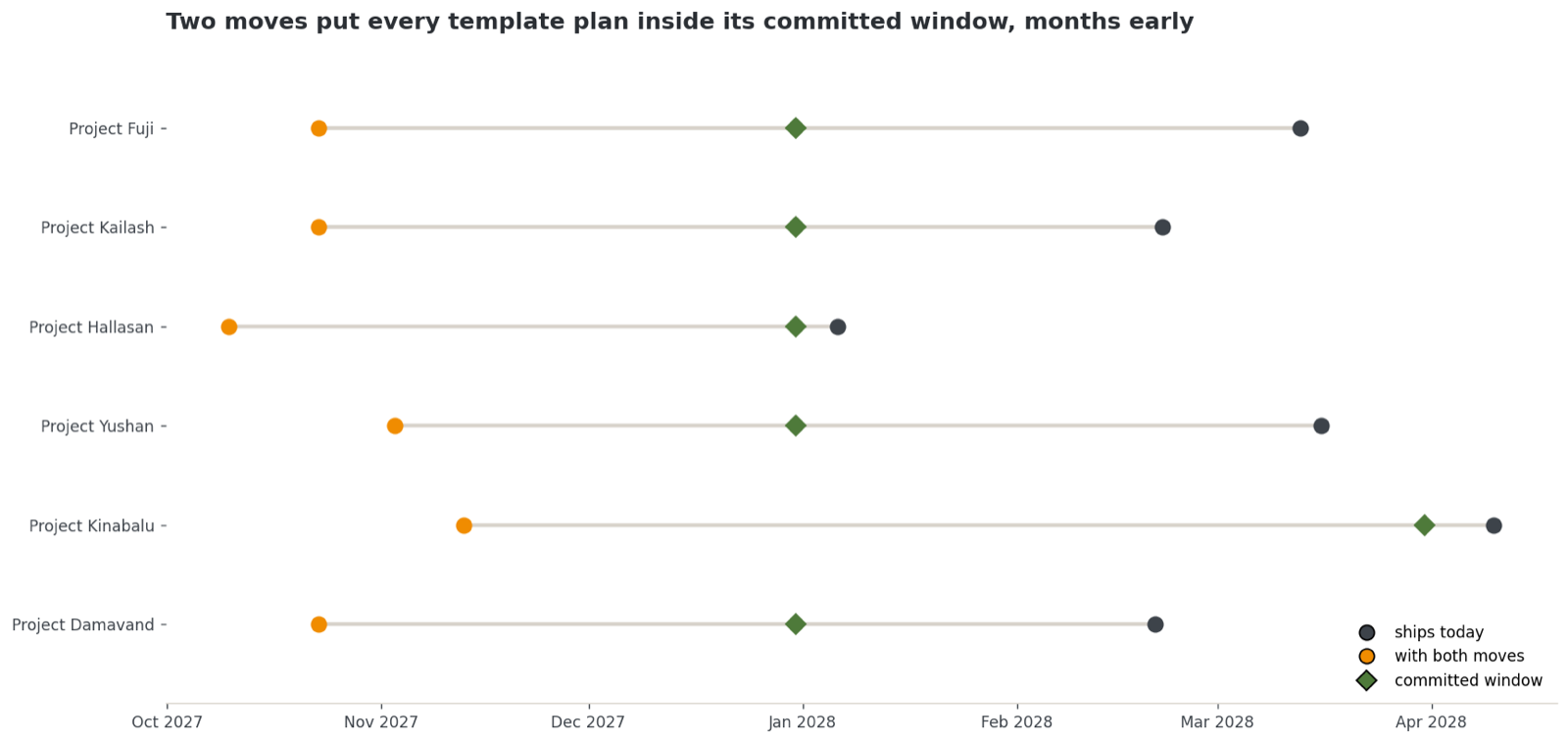
The companion pair of instruments now reads as one system. The cycle time metric told us how big the gap is and where it lives. The chain analysis tells us which levers close it, in what order, and what each is worth in days. One is the diagnosis, the other is the treatment plan, and both come from the same schedule files the teams refresh in the weekly refresh, so the evidence stays as current as the plans.
The Monday move fits in two edits to one file: move the tooling order to mechanical design complete with the recut entered as a signed risk, and release the three independent front-end studies to run together. Two edits, six ship dates. A portfolio built on one template carries a gift inside the sameness: every fix is wholesale. Ten projects, one critical path. Optimize the template and the whole portfolio moves.
References: Goldratt, Critical Chain, North River Press, 1997. The full critical path analysis is attached below; the companion study is published with The cycle time metric.
Related reading: The cycle time metric, Schedule gap, My Schedule Keeps Slipping..., Pull-in before you slip, Challenge the assumptions, No Risks = No Schedule, The Weekly Schedule Refresh, and The FTTM execution system.